

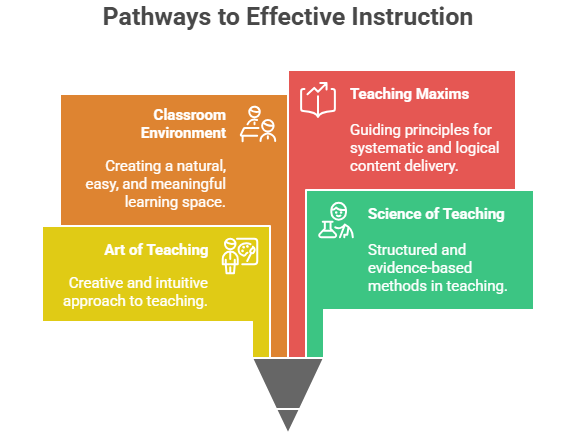
Since we know teaching is both an art and a science. An effective teacher not only knows what to teach but also how to teach it effectively. It is very important to make classroom learning natural, easy, and meaningful, and for that purpose teachers follow certain fundamental rules or principles known as maxims of teaching. Teaching maxims are of universal significance, and these maxims act as guiding rules that help a teacher present content in a planned, systematic, logical, and psychological manner. Teaching maxims that support a teacher and learning are discussed below:
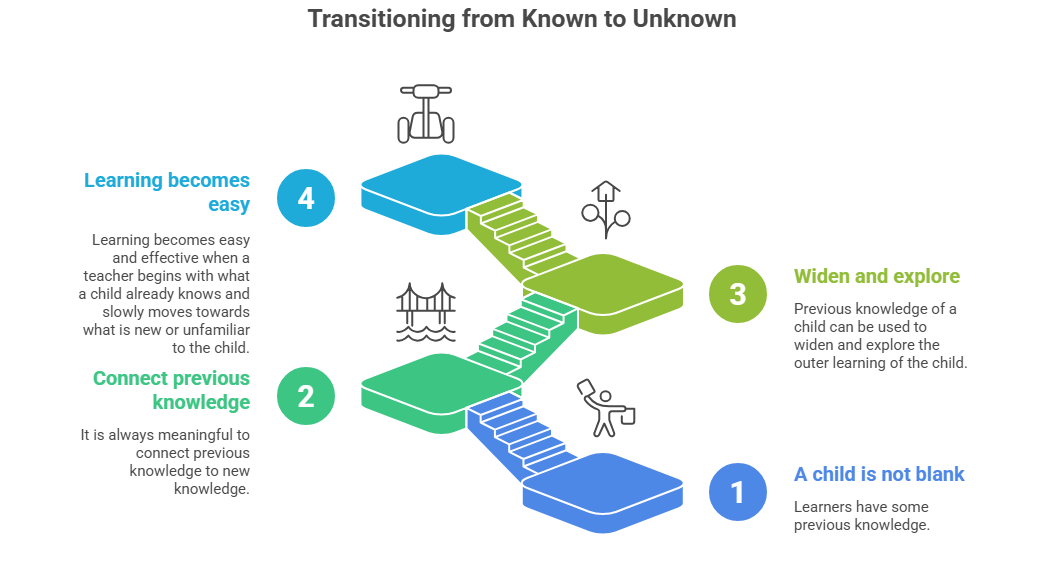
From Known to Unknown
- It is based on the fact that a child is not blank.
- Learners have some previous knowledge.
- It is always meaningful to connect previous knowledge to new knowledge.
- Previous knowledge of a child can be used to widen and explore the outer learning of the child.
- Learning becomes easy and effective when a teacher begins with what a child already knows and slowly moves towards what is new or unfamiliar to the child.
For example, when teaching a child how to ride a scooter, one should start by letting them balance on a cycle. Since they already know cycling and are familiar with cycles, learning a scooter becomes easy. Similarly, if we talk about if a teacher wants to teach all about tigers, then he should start with pet cats because students already know about pet cats. And between these two is a good resemblance, so it is easier to start with some cats and then to move towards the complex one, like tigers. This maxim boosts and builds confidence, connects old and new knowledge, and lessens the stress of learning complex topics and prevents confusion or misclarification.
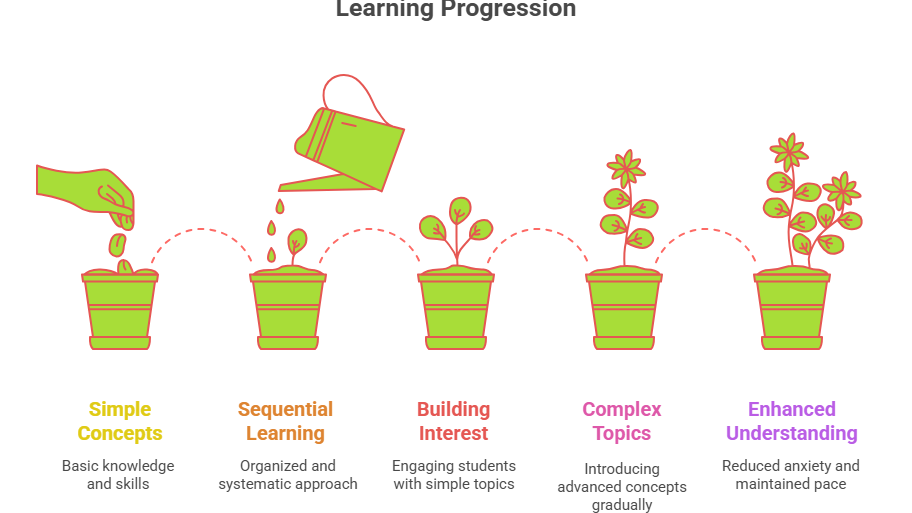
From Simple to Complex
In the teaching-learning process, being systematic, sequential, and organized is very important. We have noticed that the chapter of the book is very systematic, and it is arranged in such a manner that the child shall face no difficulty while going from the first to the last chapter. There is a simple logic that a good teacher always starts his class from a simple topic, and as children start taking interest in classroom teaching, then the teacher moves towards complex topics. If students once become curious and take interest, then it is easy and meaningful to complete classroom goals and the topic as well.
For example, in the case of teaching mathematics, students first learn counting (1,2,3…) and the table system, then addition, subtraction, and later complex concepts like algebra or trigonometry.
It is important to use the simple-to-complex maxim because it reduces anxiety, enhances understanding, and maintains the learning pace among students.
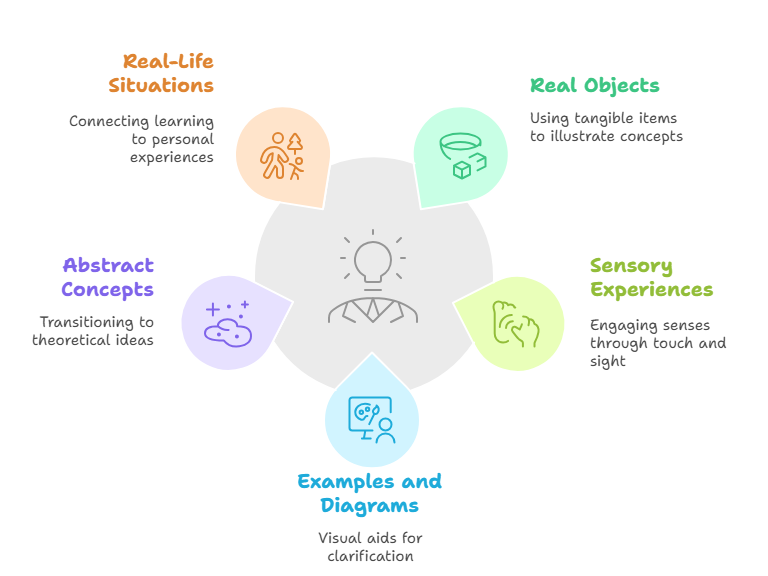
From Concrete to Abstract
Students are always curious about things that are real and touchable and that they can manipulate. These things help a child in understanding abstract concepts with ease because touchable, visible things are better than imaginary or conceptual ideas. For use of concrete to abstract maxims of teaching, here are a few key points one should keep in mind.
- Present real objects to clarify conceptual ideas. (use some objects to teach numbers and letters and the numerical operations.)
- Include sensory experiences. (use visual models which students can feel or touch.)
- Use of examples and diagrams. (draw diagrams and charts for clarification.)
- Transaction of abstract concepts (once children understood the concrete examples, then use a formula or rule for making them understand the conceptual idea).
- Linking to a real situation. (connect the learning to child’s own experience of life)
For example,
To teach the shape of a circle, one can start with a real chapati or bangle. Later, students understand the geometric symbol (o). Before teaching the physical existence of solar planets, one can start with showing the picture of the solar system. The use Concrete examples help to form mental images, making abstract ideas easy to understand.
From Particular to General
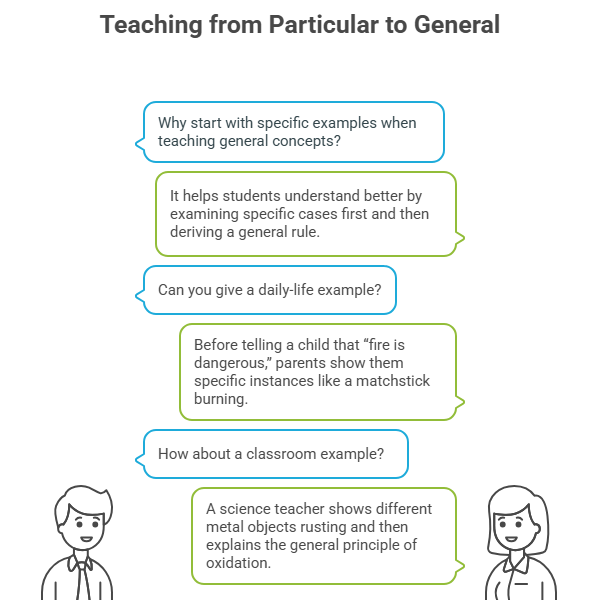
In the teaching-learning process, the general concepts, facts, and rules are not easy to teach and make students understand easily; therefore, the teacher starts from very particular to general while teaching any general rule and concept. This gives a better understanding among students Students understand better when they examine specific cases first and then derive a general rule.
Daily-Life Example
Before telling a child that “fire is dangerous,” parents show them specific instances—like a matchstick burning or a candle flame—so the child generalizes the learning. A science teacher shows different metal objects rusting and then explains the general principle of oxidation.
1. What is meant by maxim of teaching?
Teaching maxims are of universal significance, and these maxims act as guiding rules that help a teacher present content in a planned, systematic, logical, and psychological manner.
2. Why is the maxim of teaching important?
It is very important to make classroom learning natural, easy, and meaningful.
3. What is meant by the concrete-to-abstract maxim of teaching?
Students are always curious about things that are real and touchable and that they can manipulate. These things help a child in understanding abstract concepts with ease because touchable, visible things are better than imaginary or conceptual ideas. For use of concrete to abstract maxims of teaching, here are a few key points one should keep in mind.
1. Present real objects to clarify conceptual ideas. (use some objects to teach numbers and letters and the numerical operations.)
2. Include sensory experiences. (use visual models which students can feel or touch.)
3. Use of examples and diagrams. (draw diagrams and charts for clarification.)
4. Transaction of abstract concepts (once children understood the concrete examples, then use a formula or rule for making them understand the conceptual idea).
5. Linking to a real situation. (connect the learning to child’s own experience of life)